
Letter Boxed Answers Today – NYT Game Solver & Latest Hints
Letter Boxed Answers, Hints and Solutions For July 7, 2026
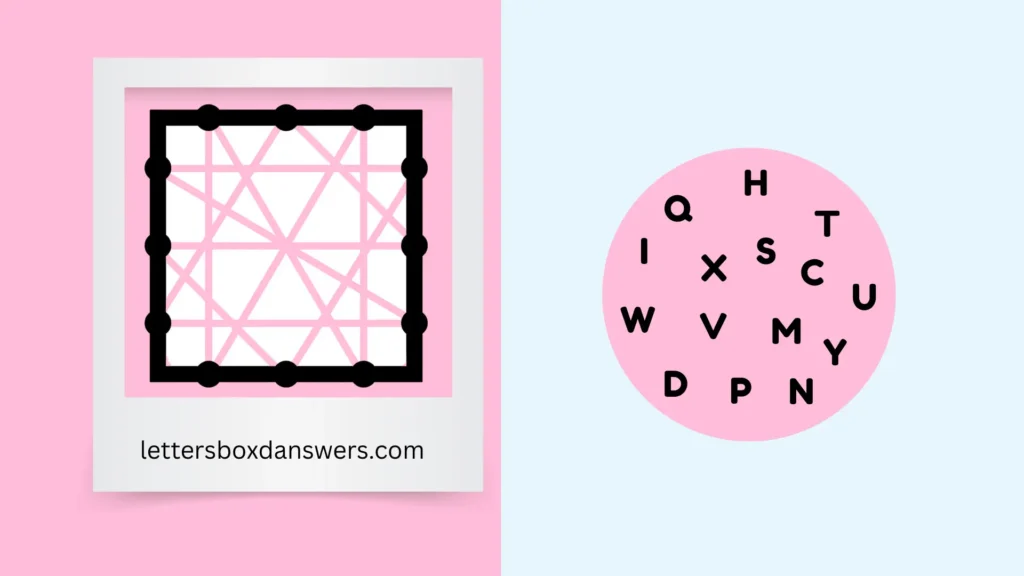
You opened the nytimes puzzle page today. You looked at twelve letters sitting around a square box. Maybe you tried two words, maybe three and nothing clicked. That moment of being stuck is exactly why this page exists. You get today’s Letter Boxed answers here, along with some clues, hints and the thinking behind every solution so tomorrow feels easier than today did.
What is LETTERBOXED?
The game comes from the New York Times Games team. Sam Ezersky, the NYT puzzle editor, built it in 2019. It launched after the Crossword and Spelling Bee and it found its audience quickly because it does something those two games do not. It forces you to think in chains not in isolation and alone.
The game places twelve letters around the four sides of a square, three letters per side. You have to build words using those letters. Each new word you play must begin with the last letter of the word you just finished. Every letter on the board must appear at least once by the time you stop. The fewer words you use to get there, the better your result.
Two words is the standard you want to reach. Most daily boards have at least one valid two-word solution. Finding it on your own, using only the letters given, is what separates a strong player from someone who just guesses until something works.
That is the entire game. The rules are simple to learn. Applying them under pressure is where the real challenge begins. You can play it online for free without creating an account or downloading anything.
How To Play Letter Boxed?
Before you type a single letter, just scan the board for thirty seconds. This habit alone will improve your results faster than any other tip in this guide.
You are looking for three things during that scan. First, find the unusual letters. Any Q, Z, X, J, or K on the board needs a plan before you start. These letters fit into far fewer words than common ones, and if you leave them for last you will often find yourself stuck with no clean way to use them.
Second, notice which letters share a side. The core rule of this game is that two consecutive letters in a word cannot come from the same side of the box. If you see T, R, and S all on the same side, you cannot write a word where T and R appear next to each other, even though they form the start of dozens of common words. Knowing your restrictions upfront saves you from wasted attempts.
Third, look for the letter that sits at a natural bridge point between your two planned words. Because your second word must begin where your first word ends, the final letter of word one is your hinge point. Picking that hinge letter well is often the whole puzzle.
Once you start playing, you connect letters by tapping or clicking them in sequence. The game highlights valid moves automatically. If a connection turns red, those two letters share a side and the move is illegal. Letters can be reused across the puzzle, but the no-same-side rule still applies in all time.
Letterboxed Nyt Game Strategies
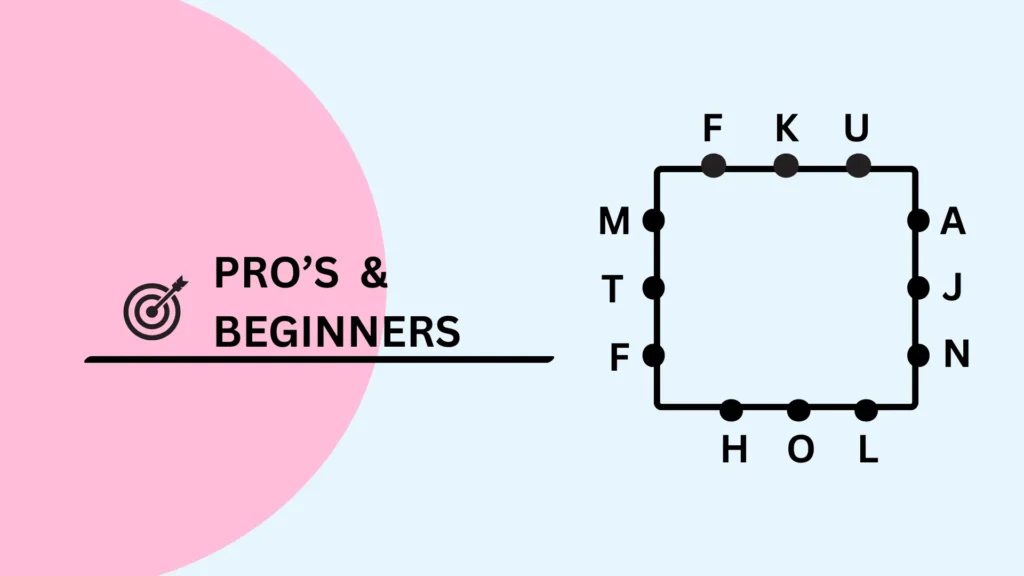
Nytimes letterboxed rewards players who treat it as a planning exercise, not a memory test. Knowing ten thousand words matters far less than knowing how to read a board and map a path across it.
Strategies For Beginners
Start by aiming for three words instead of two. This removes pressure and lets you focus on learning how the chaining rule actually feels in practice. Once three-word solutions start coming easily, you will naturally start spotting the shortcuts that collapse them into two.
Look at letter pairs that show up in common English words. Combinations like ST, ER, IN, TH and ON appear constantly in everyday vocabulary. When you spot these pairs sitting on different sides of the box, they become building blocks for longer words that cover more of the board per move.
Write the twelve letters down on paper before you start if you play on a phone. Group them by side. This physical representation makes the side restrictions visible in a way that staring at a screen does not always provide. Many players who struggle with the app on mobile solve it in minutes with a pen and notepad beside them.
Play the archive. Past puzzles are available through community sites and solving old boards is the fastest way to build pattern recognition without the pressure of today’s reset clock. Some third-party solvers also offer unlimited practice boards so you can drill specific letter configurations as many times as you need.
Strategies For Pro’s
Experienced players approach each board with a specific goal: find the word that carries the most letters and ends on a high-value hinge point. A high-value hinge is a letter that starts many common English words, things like S, T, R, A, and C. Ending your first word on one of those letters gives your second word the widest possible starting range.
Work backwards from the rare letters. If the board has a Z, find every valid word that uses it and treat those words as fixed anchors. Build your two-word plan around those anchors rather than trying to wedge the Z in at the end.
Think in suffixes. Words that end in TION, MENT, NESS, IGHT, and OUND often cover four or five letters in a single suffix while touching multiple sides of the box. A word like BRIGHTNESS or TREATMENT can knock out seven or eight letters in one shot, leaving a clean short word to finish things off.
Watch the vowel distribution. If five of the twelve letters are vowels, the board is begging for long vowel-heavy words. If there are only two or three vowels, shorter punchy words with tight consonant clusters tend to work better. Read what the board is telling you instead of forcing a strategy that does not fit the layout.
Letter Boxed Nyt Rules And Techniques
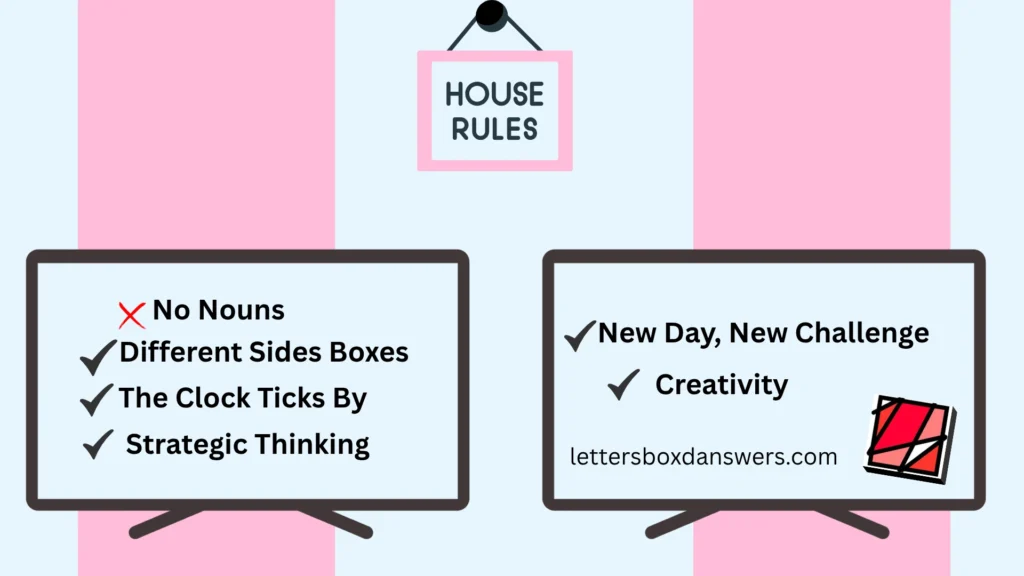
The rules take two minutes to read and months to fully understand. Each one shapes your options more than it first appears to.
No Proper Nouns
The NYT word list behind accepts common English words only. No names, no cities, no brand names, no abbreviations. This sounds limiting but it actually clarifies your thinking. When you eliminate the vast category of proper nouns, you focus on the everyday vocabulary that the game actually rewards, words like FLANK, GRAIN, ROSTER, AMBER, TWINE and SULFUR.
Players who know a wide range of common nouns, verbs, and adjectives consistently outperform players who have a large vocabulary built mostly around names and specialized terminology.
Two Consecutive Letters, Two Different Side Boxes
This is the rule that defines it more than any other. It means you are always moving around the box as you spell, bouncing from side to side with every letter. You can return to a side as often as you like, you just cannot use two letters from it back to back.
In practice, this rule eliminates many short common words because their letters cluster on a single side of the board. It also creates opportunities for unusual longer words that zigzag across the square in ways that feel impossible until suddenly they fit perfectly.
The Clock Ticks By
The puzzle has no official arrival timer, but the daily reset at midnight creates its own kind of deadline. Many players feel pressure to solve the puzzle before seeing someone else’s shared result on social media, which makes a spoiler feel like a clock running out.
The real skill here is slowing down when you feel rushed. The boards that stump you most are usually the ones where you spent the first three minutes typing random words instead of reading the layout. A calm sixty-second scan before your first move will consistently outperform five minutes of frantic guessing.
Strategic Thinking
Every move has consequences two moves ahead. The word you choose first determines what letters remain, where your second word must begin and whether a clean solution even exists from that starting point. Players who think one word at a time hit dead ends. Players who think in pairs find solutions.
Before committing to your first word, ask yourself one question: what letters does this leave behind, and can those letters form a valid word starting with my last letter? If the answer is yes, play the word. If the answer is unclear, keep scanning.
Creativity
Its word list accepts a broader range of valid English words than most players expect. Words they learned in books but never use in conversation, words from science, cooking, music, and geography, often appear as valid answers. When you exhaust the obvious common words, think about vocabulary from specific fields you know well.
A person who reads a lot of historical fiction may find solutions in words others overlook. A cook may recognize food-related terms that crack a board wide open. Your specific knowledge base is an asset in this game.
New Day, New Challenge
Every morning at midnight the board resets and everything you figured out yesterday becomes irrelevant. This daily reset is what keeps it from becoming stale. No two boards share the same letter distribution and the strategies that cracked Tuesday’s puzzle may do nothing for Wednesday’s.
This is also what makes the game genuinely competitive. Players compare results based on word count, and because everyone faces the same board each day, the comparison is fair. Finding a two-word solution on a hard board feels like a real accomplishment because it is one.
What Makes The Letter Boxed Game Popular?
The game sits in a category of puzzle games that grow in popularity through daily repetition. The same mechanism that makes people return to it each morning is what makes it feel meaningful when they do.
Unique
No other major word game combines letter chaining with the side-restriction rule the way this game does. Wordle tests guessing. Spelling Bee tests vocabulary. The Crossword tests knowledge. Th game tests your planning. Players who want a puzzle that requires actual strategic thought rather than pattern matching or recall find it here and rarely leave.
Accessible
The game runs in any browser on any device at no cost. You do not need an account. You do not need a subscription. You tap or click letters to form words, and the interface tells you when a move is valid or invalid in real time. A ten-year-old can understand the rules in under a minute. A veteran puzzle solver can spend twenty minutes on a single board without solving it. That range is rare.
Challenging
The gap between understanding the rules and actually solving the puzzle in two words is significant. Most new players need four or five words to clear a board in their first few weeks. Getting to three words consistently takes practice. Cracking two words regularly takes months of daily play and real strategic development. That ladder of improvement keeps players engaged far longer than games with a fixed difficulty ceiling.
Free
The daily puzzle on the New York Times website requires no subscription. The game free access model is one of the clearest reasons for its size and diversity of audience. When a puzzle costs nothing and delivers a genuine cognitive challenge every single day, word spreads naturally.
Novelty
Each board delivers a fresh arrangement of letters with its own personality. Some days the vowels are generous and long words flow easily. Other days the consonant clusters make every word feel forced. The game does not recycle boards, which means every morning offers something genuinely new rather than a rotation of familiar setups.
Continuous Learning
Players who engage with over months report noticing real vocabulary growth. Not because the game teaches words explicitly, but because it creates a situation where discovering a new valid word is immediately rewarding. That reinforcement loop makes new vocabulary stick in a way that passive reading does not always achieve.
Advantages Of Playing LetterBoxed Game
The benefits of playing daily extend beyond puzzle satisfaction. Regular players describe cognitive effects that carry over into their working and reading lives.
Stimulates The Brain
Each session activates planning, pattern recognition, and verbal processing simultaneously. These are not passive cognitive functions. They require active engagement, and using them in a structured daily context keeps them sharp. Researchers who study cognitive aging consistently find that complex word and strategy games provide meaningful mental exercise when they practiced regularly.
The game quietly introduces players to valid English words they would never think to use in conversation. When you discover that WAXWORK or OUTSTRIP or QUANDARY solves a board, that word moves from passive recognition to active memory. Over months of daily play, that shift compounds into a meaningfully broader working vocabulary.
Release Stress
Focused puzzle solving occupies the mind fully, which crowds out the anxious background thinking that fuels stress. The cognitive demand of the game is high enough to require your full attention but low enough to avoid frustration in most sessions. That balance creates a reliable mental reset that many players describe as the best part of their morning routine.
Works On Memory And Cognition
Tracking which letters you have used, which sides they came from, and what remains available is active working memory. Doing this daily strengthens the same mental infrastructure that supports reading comprehension, task switching and information retention. Players who stick with Letter Boxed long enough often notice that they hold information more easily in other areas of their lives.
Entertaining
The satisfaction of a clean two-word solution is immediate and unmistakable. There is a specific feeling when your second word lands and every letter lights up as used, a small but real moment of completion. That feeling is the core of why people return every morning, not because they have to, but because they want to feel it again.
Letter Boxed Solution, Tips and Tricks
When you get stuck, these are the techniques that actually move you forward.
Identify your hardest letter first, then build your entire strategy around it. If the board has a Q, you need a word with Q in it. Find every possible Q word the board allows and treat the best one as your foundation. Everything else follows from there.
Use suffixes as coverage tools. A single word ending in MENT, NESS, TION, or IGHT can cover four to five letters in one move while jumping cleanly across multiple sides. Planning your first word around a strong suffix often reveals your second word automatically because the leftover letters cluster into something obvious.
Count what remains after your best first word. If seven letters are gone and five remain, ask whether those five can form a single word beginning with your last letter. If yes, you have your solution. If no, try a different first word. This systematic check is faster than random experimentation.
Count what remains after your best first word. If seven letters are gone and five remain, ask whether those five can form a single word beginning with your last letter. If yes, you have your solution. If no, try a different first word. This systematic check is faster than random experimentation.
Think about your hinge letter before you commit to anything. The letter that ends your first word opens or closes your second word options dramatically. A first word ending in A, E, I, O, or common consonants like T, R, S, and N gives you maximum flexibility. A first word ending in V, X, or Q puts you in a narrow corridor.
Practice on old boards until two-word solutions start feeling natural. The pattern recognition that makes Letter Boxed easy develops through repetition with specific board types. The more distinct board configurations you solve, the faster you read new ones. If you want extra help between sessions, a Letter Boxed solver can show you valid word chains for any custom board so you can study the logic rather than just guess.
Conclusion
Letter Boxed earns its place in the daily routines of serious puzzle players because it asks something no other NYT game asks. It asks you to plan, not just to know. The vocabulary helps, the strategy matters more, and the ability to read a board in the first thirty seconds matters most of all.
The players who get best at on it are the ones who treat each puzzle as a brief but genuine problem to solve, not a vocabulary quiz to pass. They scan before they type. They think about their hinge letter before they commit. They build strategies around the hardest letter on the board, not the easiest word they can see.
Come back each day for the latest answer, hints and the thinking behind the solution. The goal is not just to show you what the answer is, but to help you understand why it works so the next board feels a little more like yours to crack.
To get more information about this site, you can go to About Us
Frequently Asked Questions
THANKS FOR COMING!